

ARR from the ground up
ARR is the most-quoted number in SaaS and one of the most loosely defined. Everyone reports it; far fewer can say exactly how it’s built, or why two teams’ ARR for the same company disagree. This post is a ground-up definition—what ARR is, what counts as recurring, why it matters, and how it’s derived from transactions.
What is ARR and why does it matter?
ARR (annual recurring revenue) is the annualized run-rate value of every recurring contract in force on a given date.
ARR is a point-in-time figure, like the balance in a bank account: it only means something as of a specific date. It is not the money that flowed in during a period—it’s the run rate you’re carrying right now. Bookings and churn are the flows that move the balance; ARR is the balance itself. Keeping that distinction straight prevents most ARR confusion.
SaaS companies are valued on ARR, usually as a multiple of it, because recurring revenue is the durable, predictable core of the business. A dollar of ARR is worth far more than a dollar of one-time revenue: it shows up again next year without being re-sold.
Beyond valuation, ARR earns its place because of what its structure gives you:
It’s forward-looking. ARR is the run rate you carry into the next period, independent of when invoices happen to land. Billing timing—annual up front, monthly, quarterly—doesn’t distort it.
It’s comparable and decomposable. Because it’s a balance measured the same way every period, you can line ARR up over time and ask where it moved: new business, expansion, contraction, churn. That decomposition is the basis for retention and growth metrics like gross and net revenue retention.
It normalizes noise. Annualizing and stripping out non-recurring items puts a six-month deal, a monthly SMB subscription, and a three-year enterprise contract on the same run-rate basis, so they can actually be compared.
In short, ARR is what lets you measure the business against itself over time and against other businesses—which is exactly why discipline matters in how it’s built.
What counts as “recurring”
“Recurring” is doing quiet work in that definition, so it’s worth pinning down. Three patterns come up, and they don’t all count the same way.
A subscription with an expectation to renew—recurring. The clean case: a customer signs up for ongoing access and the contract continues unless cancelled. A Netflix subscription, a seat of software, a SaaS platform. The revenue is contractual and expected to continue, which is exactly what ARR exists to measure.
A product or service bought over and over—usually not recurring, for ARR. Plenty of revenue recurs without being contractual. A customer who reorders the same consumable every month—printer toner, lab reagents, replacement filters—produces a predictable, repeating stream, but each order is a fresh, uncommitted decision, and nothing obligates the next one. Because ARR is meant to capture committed recurring revenue, repeat purchases like these are generally treated as non-recurring: counted when they land, not annualized into a run rate.
A usage-based subscription—recurring, but measured differently. Some contracts are ongoing subscriptions—so the relationship is recurring—but priced on consumption: you pay for what you use. An electric utility is the everyday version—you’re a continuing customer, but the bill moves with the kilowatt-hours. This revenue is recurring, yet you can’t read it off a fixed annual contract value, because there isn’t one. Measuring ARR for usage-based products takes its own approach—a run rate built from actual consumption—which is a post of its own.
Annualized and in force
With the recurring contracts identified, two mechanics remain: annualizing each one, and deciding which periods it counts in.
It’s annualized. ARR is based on Gross ACV—annual contract value, grossed up to a full-year run rate. A six-month contract for $500 has a Gross ACV of $1,000, because the annual run rate is $1,000. A customer who renews on a six-month term hasn’t reduced your run rate, and Gross ACV keeps that short contract from looking like a cut.
It’s not TCV. Total contract value is the whole cash value of a deal, non-recurring included, un-annualized. TCV answers “how much did we sell”; ARR answers “what’s our recurring run rate.” A $1.2M three-year deal is $1.2M of TCV and $400K of ARR.
It’s in force. A contract counts toward ARR on a given date when it is active—it has started and hasn’t yet ended:
Effective Date ≤ ARR Date AND Service End Date ≥ ARR Date
One subtlety deserves its own paragraph: the effective date. Contracts get booked late—the order is entered after service was meant to start, with late renewals the classic case. If you used the raw service start date, a late booking might reach back and restate ARR balances you had already closed and reported. That’s ARR hindsight, and it quietly erodes trust in the numbers.
The fix is to enter ARR on an effective date—the later of the service start date and the transaction date. Said another way, a contract can’t be in force until after it’s booked.
Effective Date = MAX(Service Start Date, Transaction Date)
Now a booking that lands late shows up in the current period, not the closed one. Past balances stay put; the number you reported last quarter still ties. Understanding the impact these late renewals have on the ARR balance—a drop and subsequent recovery—is an essential part of evaluating performance while keeping a disciplined ARR definition.
Building ARR from transactions
The best ARR models trace cleanly back to their source transactions. ARR should be derived straight from those lines, as long as each one carries three facts:
- Service start date
- Service end date
- Total contract value (TCV)
From those facts, you derive two more:
- Term months—from the start and end dates.
- Gross ACV—
TCV ÷ term × 12, the annualized run rate.
ARR on any date is then the sum of Gross ACV for every line in force on that date: effective date on or before it, service end date on or after it.
Detailed examples
To demonstrate, here are two examples—an expiring contract and its renewal, one booked early and one booked late.
| Transaction | Transaction Date | Start Date | End Date | TCV | Effective Date | Gross ACV |
|---|---|---|---|---|---|---|
| A-001 | 4/25/2025 | 5/1/2025 | 4/30/2026 | 1,200 | 5/1/2025 | 1,200 |
| A-002 | 4/25/2026 | 5/1/2026 | 4/30/2027 | 1,260 | 5/1/2026 | 1,260 |
| B-001 | 4/25/2025 | 4/30/2025 | 4/29/2026 | 1,200 | 4/30/2025 | 1,200 |
| B-002 | 5/2/2026 | 4/30/2026 | 4/29/2027 | 1,260 | 5/2/2026 | 1,260 |
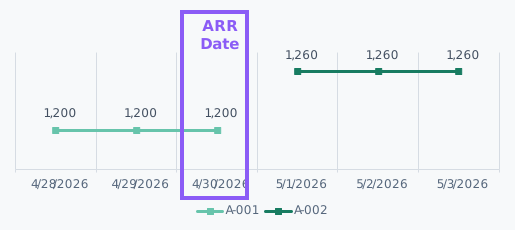
Even though A-002 is booked early (4/25/2026), its effective date is still its start date, 5/1/2026—so only A-001 is in force as of 4/30/2026. Booking early doesn’t pull ARR forward.
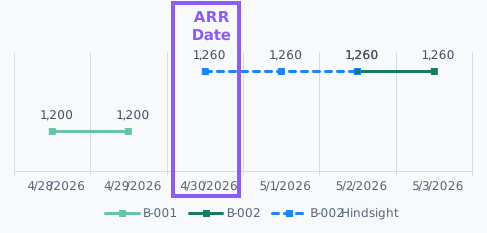
Contract B is booked late. B-001 ends on 4/29/2026, so it’s not in force on the 4/30/2026 ARR date, and because B-002 was booked after its start, its effective date is the transaction date, 5/2/2026. That leaves a two-day gap where neither contract is in force, so ARR dips on 4/30/2026 and recovers on 5/2/2026.
Where this goes next
That’s ARR as a definition: an annualized, recurring-only, point-in-time balance, derived from the contract lines underneath it.
A balance tells you where you are, not how you got there. The next post takes the ARR roll-forward: how the balance moves from one period to the next, where new business and churn show up, and the identity that ties it all together.